How Does IPTV Work? A Complete Beginner’s Guide
If you're tired of expensive cable bills and rigid channel packages, you have likely heard about IPTV. But if you have never used it before, the technical jargon can seem overwhelming. This comprehensive beginner’s guide will break down exactly what IPTV is, how it functions, what devices you need, and how you can get started streaming live television over the internet today.
Whether you are looking to watch live sports, thousands of movies, or international channels, understanding the foundation of this technology is the first step. By the end of this article, you will have a clear understanding of the entire process—and see how platforms like Flash4K IPTV make it easier than ever to cut the cord.
Stream 2026 NFL Games in 4K & 60FPS
Get instant access to over 50,000 live sports channels, 120,000+ movies & series, and 24/7 priority sports coverage across all your favorite devices.
1. What Is IPTV?
IPTV stands for Internet Protocol Television.
To understand what that means, consider how you traditionally receive television. With cable or satellite, broadcasters send signals through dedicated cables or via satellite dishes directly into a set-top box in your home. You receive whatever they broadcast exactly when they broadcast it.
IPTV completely changes this delivery method. Instead of using traditional broadcast infrastructure, IPTV delivers television content using the internet. When you stream a YouTube video or watch a show on Netflix, you are already using internet protocol to receive video. IPTV simply applies this same internet-based delivery system to live television channels, sports broadcasts, and premium movies.
Because it operates over the internet, IPTV provides immense flexibility. You are no longer tethered to a specific cable box in your living room; you can watch your favorite content on nearly any screen that connects to the web.
2. How Does IPTV Work?
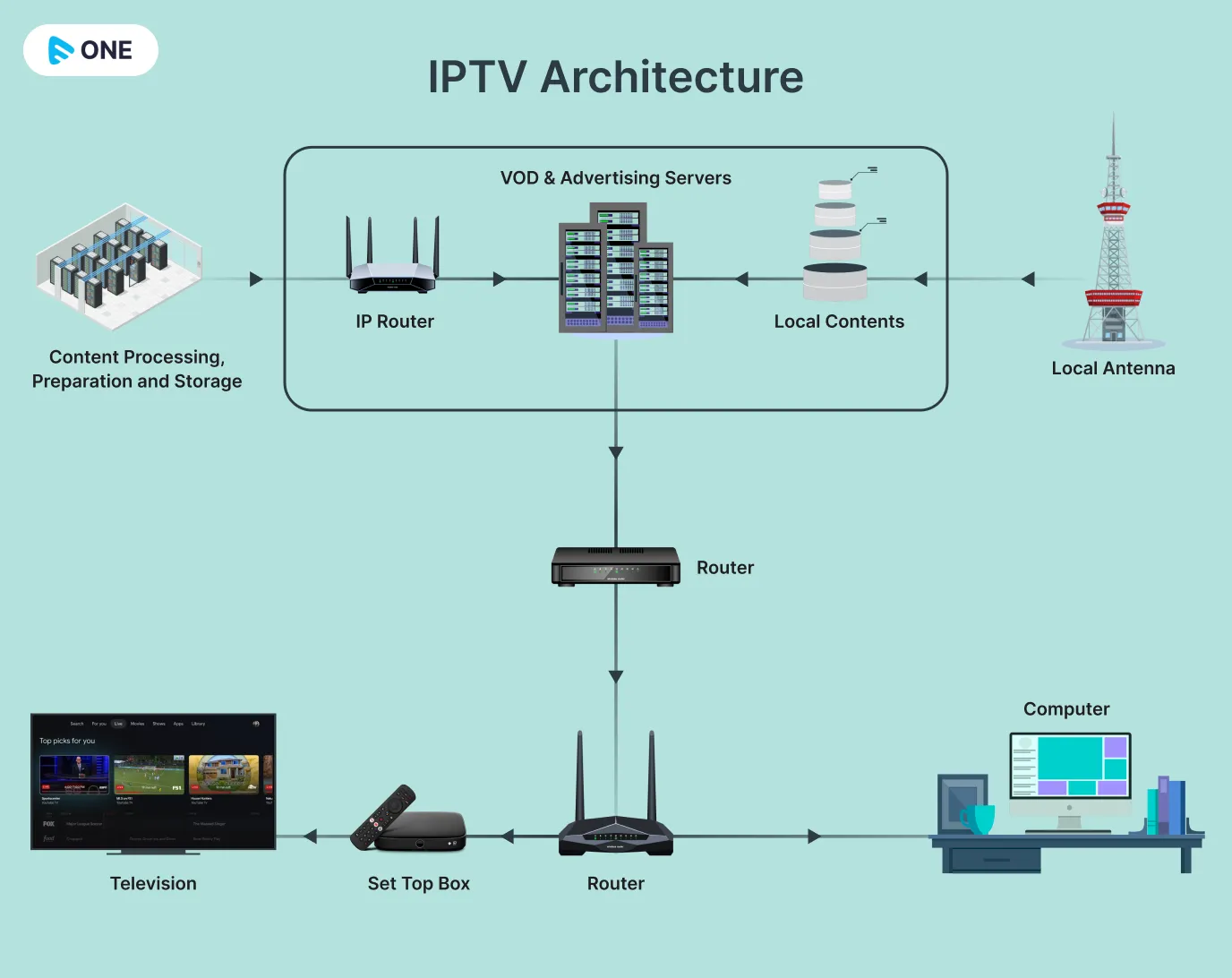
The journey from a live event to your television screen involves several steps, but the concept is remarkably straightforward once broken down. Here is how IPTV works, step by step:
- Content Source: Broadcasters and networks produce live television (like a news broadcast or a football game).
- IPTV Provider / Server Infrastructure: An IPTV service captures these live feeds and digitizes them. The video is compressed into a format suitable for streaming over the internet and stored on or distributed through powerful streaming servers.
- The Internet: When you select a channel, your device sends a request through your internet connection to the IPTV provider’s servers.
- IPTV App / Player: The server sends the requested video data back to your device in small data packets. Your IPTV application acts as a decoder, quickly reassembling these packets into a continuous video stream.
- Your Screen: The video is displayed on your television, smartphone, or computer in real-time.
This internet-based system allows providers to offer massive channel directories, as they are not limited by the physical bandwidth of a coaxial cable.
3. How Does IPTV Deliver Live TV?
Delivering live television over the internet requires constant, uninterrupted data transfer.
When you watch a live channel via IPTV, you are connecting to a streaming server that is actively broadcasting the feed. The server breaks the live video into tiny chunks of data and sends them to your device sequentially. Your IPTV application downloads these chunks, stores a few seconds of video in a temporary memory bank (the "buffer"), and plays them back.
This process is why live IPTV is sometimes a few seconds behind traditional cable—the data must be compressed, transmitted, and decoded. For the live stream to remain smooth, your internet connection must be fast enough to download the video chunks faster than your device plays them.
4. What Is an IPTV Playlist?
When you subscribe to an IPTV service, you don't usually download an app that has all the channels hardcoded into it. Instead, you are given access to an IPTV playlist.
An IPTV playlist (most commonly an M3U playlist) is essentially a digital text file containing thousands of URLs. Each URL points to a specific live channel or movie on the provider's server.
When you load this playlist into an IPTV player, the software reads the file and organizes the URLs into a clean, easy-to-navigate menu. It is important to remember that a playlist is just a list of links; if the IPTV service shuts down or a specific channel goes offline, the link in your playlist will simply stop working.
5. What Is an IPTV Player?
An IPTV player (or IPTV app) is the software you use to watch your content.
Think of the player as the television set, and the playlist as the cable wire. The player itself usually does not provide any content; it simply reads the playlist you provide and plays the video streams.
There are hundreds of IPTV players available, catering to different devices:
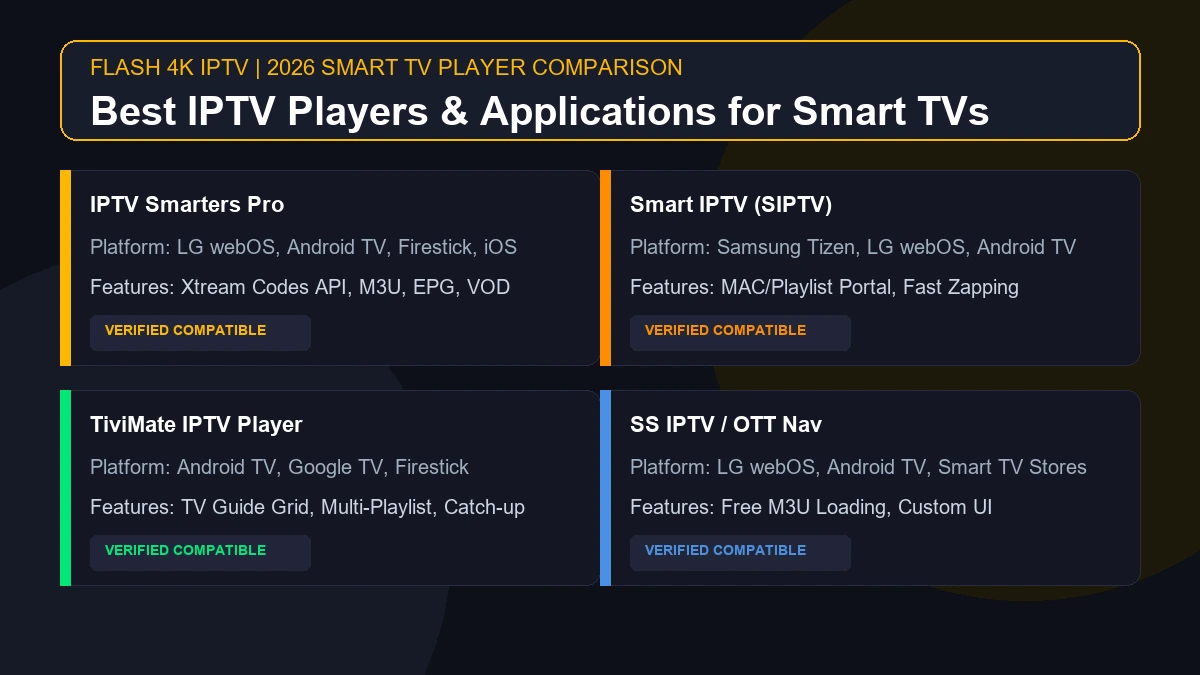
- Smart TV Apps: Applications like TiviMate, IPTV Smarters, or IBO Player.
- Mobile Players: Apps available on iOS and Android for viewing on the go.
- Computer Software: Programs like VLC Media Player that can read network streams.
Different players offer different features, such as recording capabilities, parental controls, or interface customization. For more information on finding the right app, explore our IPTV installation guide.
6. What Devices Support IPTV?
One of the greatest advantages of IPTV is device flexibility. You can run IPTV on almost any device with a screen and internet access, including:
- Smart TVs: Many modern Samsung, LG, and Android TVs support native IPTV apps.
- Fire TV / Firestick: Amazon's affordable streaming sticks are among the most popular IPTV devices.
- Android TV Boxes: Devices like the Nvidia Shield TV offer incredible processing power for smooth streaming.
- Apple TV: Supported through dedicated App Store applications.
- Smartphones and Tablets: Perfect for watching live sports or news while traveling.
- Computers: You can watch directly through web players or desktop applications.
7. Does IPTV Require an Internet Connection?
Yes. Because IPTV stands for Internet Protocol Television, it inherently relies on network connectivity to function. Without an internet connection, you cannot connect to the servers broadcasting the live channels.
When considering IPTV, you must distinguish between internet speed and connection stability. You might have a 500 Mbps download speed, but if your Wi-Fi signal frequently drops or fluctuates, your live stream will freeze. A stable, consistent connection is just as critical as raw speed.
8. What Internet Speed Do You Need for IPTV?
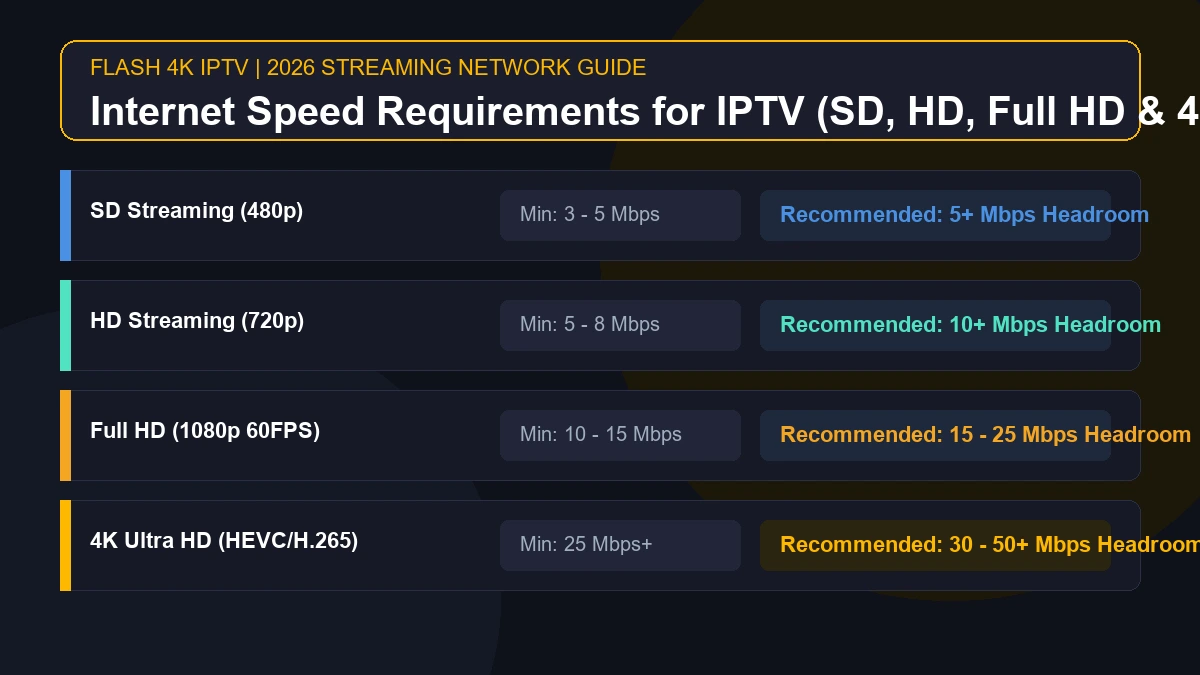
The required internet speed for IPTV depends entirely on the resolution of the video you are trying to stream:
- Standard Definition (SD): Minimum of 5 to 10 Mbps.
- High Definition (HD / 1080p): Minimum of 15 to 25 Mbps.
- 4K / Ultra HD: Minimum of 35 to 50 Mbps (with 100 Mbps recommended for stability).
These are general guidelines. If you have multiple people in your home streaming Netflix, playing online games, and browsing the web simultaneously, you will need a higher total bandwidth to ensure your IPTV stream isn't starved for data. Whenever possible, connect your streaming device directly to your router using an Ethernet cable rather than relying on Wi-Fi.
Stream 2026 NFL Games in 4K & 60FPS
Get instant access to over 50,000 live sports channels, 120,000+ movies & series, and 24/7 priority sports coverage across all your favorite devices.
9. What Is VOD in IPTV?
VOD stands for Video on Demand.
While live TV streams events as they happen, VOD functions exactly like Netflix or Hulu. It is a library of recorded content—movies, TV series, documentaries, and past sporting events—that you can browse and watch whenever you want. You can pause, rewind, and fast-forward VOD content because the entire video file is sitting on the server waiting for you to access it, unlike a live broadcast.
10. What Is EPG in IPTV?
EPG stands for Electronic Program Guide.
This is the digital TV guide interface that shows you what is currently playing and what is coming up next on various channels. A good EPG makes browsing an IPTV service feel exactly like browsing a premium cable box.
The EPG is typically provided alongside your channel playlist. The IPTV player downloads the EPG data (often in an XMLTV format) and overlays the program titles, descriptions, and times onto your channel list.
11. IPTV vs Cable TV vs Satellite TV
How does IPTV compare to the traditional methods you might be used to?
| Feature | IPTV | Cable TV | Satellite TV |
|---|---|---|---|
| Delivery Method | Internet | Coaxial Cable | Satellite Dish |
| Internet Dependency | Yes, required | No | No |
| Device Flexibility | Very High (Phones, TVs, PCs) | Low (Requires Cable Box) | Low (Requires Receiver) |
| Live Streaming | Yes | Yes | Yes |
| VOD Library | Often Included | Often Included | Often Included |
| Installation | App Download | Technician Required | Technician / Dish Required |
IPTV offers unmatched portability and often significantly lower costs, but it trades the dedicated, closed-network reliability of a hardwired cable connection for internet dependency.
12. Advantages and Limitations of IPTV
To make an informed decision, it is important to look at both sides of the technology.
Advantages of IPTV
- Cost-Effective: Often a fraction of the cost of premium cable bundles.
- Massive Selection: Access to thousands of global channels and VODs.
- Device Flexibility: Watch on your TV, phone, or laptop.
- No Hardware Rentals: You don't need to rent expensive set-top boxes from a provider.
- Instant Setup: You can start streaming minutes after subscribing.
Limitations of IPTV
- Internet Reliant: If your internet goes down, your TV goes down.
- Network Congestion: Live events can occasionally suffer from buffering if the provider's servers or your local network become congested.
- App Dependency: You must use third-party apps, which can sometimes require updates or configuration.
13. Why Does IPTV Buffer?
Buffering is the most common frustration for new IPTV users. It occurs when your device plays the video faster than your internet connection can download the next chunk of data. When the memory buffer empties, the video freezes until more data arrives.
Common causes include:
- Weak Wi-Fi signals.
- Background downloads on your network.
- ISP throttling (your internet provider slowing down streaming traffic).
- Server overload on the IPTV provider’s end during major sporting events.
To fix this, try connecting your device via Ethernet, restarting your router, or using a VPN if you suspect ISP throttling.
14. Common IPTV Problems
Here is a quick troubleshooting guide for other common issues:
IPTV Not Working or Channels Not Loading
If your entire playlist fails to load, double-check your internet connection. If the internet is fine, your subscription may have expired, or the provider is experiencing downtime. You can check our FAQ page for more connectivity tips.
IPTV Login Failed
Ensure you have typed your username, password, and server URL exactly as provided. These are often case-sensitive. If you are using an M3U link, ensure the link hasn't been cut off or malformed during copy-pasting.
IPTV Has Sound but No Picture
This is almost always a codec issue. Your device is struggling to decode the specific video format of the channel. Try changing the "Video Decoder" setting in your IPTV player (for example, switching from Hardware decoding to Software decoding).
15. How to Start Using IPTV
Ready to cut the cord? Getting started is simple:
- Ensure you have a fast, stable internet connection.
- Choose a compatible device (like a Firestick, Smart TV, or Android Box).
- Download an IPTV Player app from your device's app store.
- Subscribe to a reliable IPTV service.
- Enter the login credentials or playlist URL provided by the service into your app.
- Start streaming live TV, sports, and movies!
16. Getting Started with Flash4K IPTV
If you are looking for a powerful, user-friendly entry into the world of streaming, the Flash4K IPTV service is built to deliver.
With Flash4K, users gain access to a massive directory of high-quality entertainment and sports channels. Our platform is designed to work seamlessly across a wide variety of devices, ensuring you can watch what you want, when you want. Explore our subscription plans to find the right package for you, check our channel directory to see our offerings, or read through our installation guides to see just how easy it is to get started. If you run into any hurdles, our contact support team is always ready to help.
17. What Should You Look for in an IPTV Service?
When shopping for an IPTV provider, keep these critical factors in mind:
- Device Compatibility: Does the service support the specific app or device you own?
- Channel Availability: Do they carry the local or international networks you actually watch?
- Streaming Quality: Are channels available in true HD and 60fps for sports?
- Connection Stability: Does the provider have a reputation for uptime during major events?
- Pricing: Are the terms transparent without hidden fees?
- Support: Is there a reliable way to get help if something breaks?
Always test a service on your home network before committing to a long-term plan, and remember that an Ethernet connection is your best friend when streaming live TV.